As Covid-19 grew into a pandemic, Michael Schaffer, a father of three in a dual-working household, worried a lot: about his parents in Delaware; about his highly creative, curious, and social kids, who’d had to switch to remote learning; and even about his dog, who was now sharing the home with everyone 24/7. But what Mike did not worry about was his role at Edelman, where he was Senior Vice President, Digital + Corporate. While friends, family, and colleagues all around him had to suddenly adjust to remote work, he’d already been doing it for close to 18 months. That’s how long it had been since he and his family had moved from Washington, DC, to Los Angeles for his wife’s career. Edelman was committed to supporting the shifting needs of its employees and their families, even if they had to relocate, and to that end the company had put in place a set of technologies, protocols, tools designed to help enable remote work — which had made it possible for Mike to move to Los Angeles with his family but still stay on the DC team that he loved. He felt lucky.
The It’s Working Project, where I make sense of the challenging and ever-evolving intersection between work and caregiving, has interviewed employees and HR departments about how their workplace dynamics are shifting during Covid. It’s important that workplaces get this right, because although one-third of the US workforce is considered essential and has been on the job through the Covid-19 pandemic, most of the rest of American workers have shifted to remote work, some of them probably permanently. It’s been a bumpy experience for many employers and workers, especially parents, but in recent conversations with Mike and others I’ve noticed a compelling pattern: The workplaces that are thriving today are those that had already invested in family-centric policies and are building on what they’d learned.
As late as February, when companies committed themselves to family-friendly benefits by offering flexible work days, back-up-care reimbursement, and remote working options, and by prohibiting end-of-day meetings, they typically did so in the name of recruitment, retention, and brand culture. But no longer. Some of these programs grew out of the economic realities of a formerly low unemployment rate, they’ve left organizations well positioned for the quickly shifting workplace dynamics of Covid-19. To understand how — and why — I’ve begun collecting the stories of workers.
It is the start of a long, Labor Day weekend. I’ve got a good book and some yoga on my mind. Here in Maryland, crabs may be in order as well. There are glimpses of what kept us good and giddy in the past. And really, this is a feeling that is hard to come by as we enter into the early days of September 2020.
There is much to say about our summer that was not quite recognizable. The hill we need to scale is now many miles higher as most schools are starting the year in remote learning mode. The logistics, the weight of it all is just a set-up for frustration and exhaustion. So let’s say you’ve come up with some masterful way to keep your world working…that would be remarkable really. And if so, please share!
As our dear friend Melaine Fodder Kay shares…this is tricky business. Sending love and patience to all of you. And a reminder, we want to hear your story – please share!
This topic remains top of my regular private sector agenda and close to my heart. Newly pregnant women, mothers and working parents desire and need their village. In specific, what was once a given – a community of knowledgeable caring souls eager to shine a light on the pathways and elevate women to a place of confidence set in the present tense. The concept of multi-generations of family existing in a single location is foreign to us now. My interest is not in lamenting what is lost. Rather, the idea is in building a new generation of support easily accessible and open to parents.
Here is a short list:
Breast Feeding Centers:
Offering supports from childbirth education, breastfeeding courses and of course peer groups. These low-judgement zones are focused on empowering women and sending them into their new roles with confidence and new friendships.
Peer Groups in the Workplace:
While some are part of a robust curriculum of peer based support others are more ad hoc. None are any less necessary. These groups not only offer information from what is available (as is leave and how to eek out more time from the layers of possibility) to how to return to work (where to pump, what tools are needed and which are the best) these intimate, honest collection of parents offer the essential power of community. First timers are grateful and hungry for the facts and the hacks. From there these same parents eagerly pay it forward with passion and commitment to the next generation (be it weeks, months or years) of working parents. Some of my favorite examples include Booz Allen Hamilton, Campbells Soup and Levi’s Strauss. There are many more — organizations from all industries, sizes and geographies getting it right in the workplace through connecting parents with each other.
Workplace Programs:
The formula (no pun, truly) is simple — each year a large majority of women leave the workplace due to an inability to find their way to a comfortable, functional new normal as a working mother. These women are experienced and on their way to high, C-suite level management. And these women are not to be replaced. Certainly not inexpensively and in the most organic, honest sense – not at all. Top quality talent is irreplaceable. Yet the private sector loses sight of this very quickly. What this boils down to is the need for employers to recognize their vulnerability in losing quality employees, full of passion for their work not mention institutional knowledge and years of connection to the brand as a whole. Forward thinking organizations address this by looking for better leave and return set-ups. And, as it turns out, one of the most essential is also the least expensive — formalized workplace support groups. I have spent time with BirchBox and January Digital noticing how they have crafted programs to live both as tools (pumping rooms or mik shipping) and as more private offerings (parental groups). These are not meant to feed to organization but rather nurture the individual. And, it works well.
Family:
Be it your partner, parents, sibling or community – your family is your touchstone and your gold. They cherish you and support you as very best they can. Be clear — ask for what you want, need and crave (you know that is real) and get the full-on care that they are lovingly sharing your way. One key hack — remove their judgment from your choices. If you need a date night with your co-parent ask and take it. If they offer food or house cleaning say yes with no apologies. Remember the village? You modern day version may be a bit less traditional, but it is yours. Embrace the care, feeding and experience coming your way. You will benefit from knowing how very surrounded by love you really are!
Support for Sale:
Be it via a book (The Fifth Trimester is not only a must read but also a must gift) a service (Let Mama Sleep is just that — again, accept with grace then generously give to the next Mom). A podcast (The Double Shift or The Longest Shortest Time) or simply new approaches via Werk or One Million Work for Flexibility – find the intel you need to keep yourself strong and yes, supported.
Support is the thing. Simple, essential and offering an extremely high return for all involved.
We want to hear where you found your support! Click here to share your story with us.
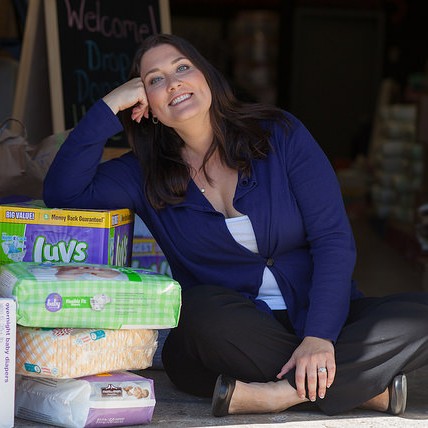
The DC Diaper Bank is approaching it’s ten year anniversary. The number of families served and the power of this much-needed care and support points directly to the amazing tour de force that is the remarkable Corinne Cannon. She has not done this alone, not by a long shot. And that is all part of Corinne’s magic. A decade ago, she realized that there was an extreme unmet need. One in five families in the greater DC metro area live below the federal poverty level, and zero percent of their diaper needs are met by food stamps or subsidies. Corinne set out to answer the call. And with that she brought with her a universe of able and eager volunteers to meet the need. Corinne gives the word driven an whole new meaning. And we wanted to share a bit about her work as well as Corinne’s world as a working mother.
We are kicking off our week of giving by not only shining a spotlight on Corinne and the DC Diaper Bank, but also offering a simple way to be part of the solution. Share your story and the It’s Working Project will donate a package of diapers in your name. Click here to share your story.
This has been a year of stepping up. One in which we gave on so many levels. Some in an effort to course correct, to right the wrong path that seems omnipresent and toxic, to protect ourselves and future generations from what threatens and scares us. And some, simply to remind ourselves that we are not at all helpless as long as we can support and share with each other.
We have voted, marched and given of ourselves – connected with others in a desire to create change.
And, on a more personal level, we have loved, nurtured, advised, and shared the joy with those who mean so very much to us. We have mourned, wept and lost by their sides as well. And we have generously given our support to those who fell to a lousy blow of fate or timing or some larger force we cannot explain.
We have been there. We will be there.
Why?
There is a buzz to giving. It has its own adrenaline. Something that demands relatively little but gives back so very much.
In an interview this week, we spoke a great deal about authenticity. And to me giving is just that, an authentic gesture of care, one that requires nothing – no reciprocation, no quid pro just a simple “thank you” — easy enough.
I saw a woman give another woman directions last week. Simply put — take a left, take a right and your destination will be on your right (no it was not Waze, this was person to person contact). As the woman began on her way to take that first left, I noticed a smile blossom on the face of the direction giver. She had the buzz.
It is the buzz that gives us hope and reminds us that we have each other. And for that we will all remain generous and grateful as there is truly a gift in giving.
Here is to all of us. Our capacity to love and to create. And our desire to care well for each other.
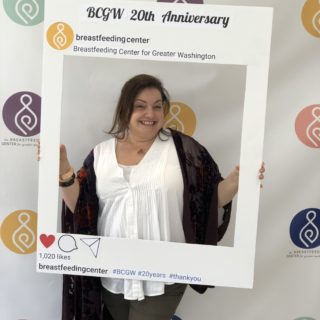
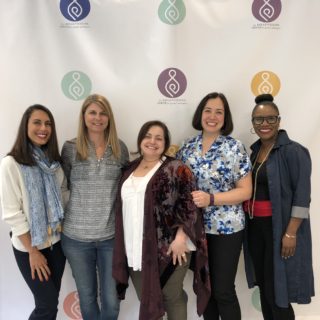
What an amazing accomplishment. The Breastfeeding Center of Greater Washington celebrated 20 years of providing support, community, classes, care and all the hacks a new mom needs. The center, now in newly expanded space on 19th Street, NW offers more series than ever – Washington’s parents have never been more fortunate. I am proud to sit on the board and help pave the way for future generations to come.
Some highlights from the day:
Fun!Thank you to my remarkable panel!How about that nipple cake?
As we hit the dogs days of summer, we find ourselves looking ahead and planning for fall, when really we have weeks to go still with the tricky issue that is summer childcare. Julia Beck spoke to NPR‘s, Lizzie O’Leary – take a listen here.
This article was originally published in the Washington Post on January 24, 2017
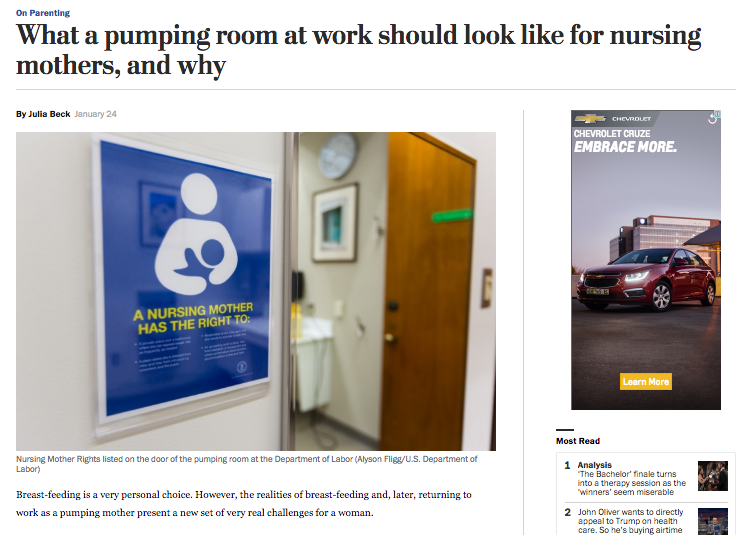
Breast-feeding is a very personal choice. However, the realities of breast-feeding and, later, returning to work as a pumping mother present a new set of very real challenges for a woman.
Workplaces that support a mother in her return to work by bringing her back with ease always win. Committed employers are not only supporting infant health, they are also establishing a powerful statement of collaboration, underscoring how much they value their employee. Although the repeal of the Affordable Care Act might mean organizations no longer legally have to provide the space or time for women to pump at work, many companies know that providing this is not only kind, but also simply a smart business move.Birch Box, for example, offers hospital grade pumps, snacks and a comprehensive booking system for its growing population of mothers in the workplace.
Lauren Pfeiffer was out for 12 weeks after the birth of her second daughter. When she returned to New Jersey-based Association Headquarters, she was greeted with brand new private “mother’s room” that held comfortable seating, a sink, refrigerator, a mirror and even a shared calendar for booking the space. The space made her return to work much more seamless, and the fact that her company set it up made her feel supported and grateful. The room was set up for quiet but also allowed for Pfeiffer to catch up on emails as she pumped breast milk for 20 minutes two to three times a day.
[Did you or do you pump at work? Tell us about your experiences below.]
It is this piece of the puzzle that is my focus at the It’s Working Project. Not only do we gather and share stories of how parents in the U.S. transition back to work, the project also partners with workplaces to help them establish easy-to-execute programs to support working families.
As was the case with Association Headquarters, not only was the pumping room a wise thing for her company to do, but it’s also the law.
Washington D.C. has recently passed legislation and joined 18 states to pass enhanced pregnancy and nursing protections that offer strong protections (and also serious penalties for offenders) for a wide range of workers and situations. Many of these state statutes, including D.C.’s law, also clarify and strengthen the rights of nursing mothers.
“Unfortunately, there is still a tremendous amount of confusion about the rights of pregnant workers,” said Dina Baskt, co-president of A Better Balance, an organization that works with lawmakers to enact legislation to help pregnant and nursing workers. “Thankfully, a growing number of states and localities, including D.C., have stepped in to guarantee pregnant workers a clear, statutory right to reasonable accommodations — the same standard in place for workers with disabilities. Many of these statutes also clarify and strengthen the rights of nursing mothers. Ensuring that pregnant workers and new mothers can avoid the impossible choice between a paycheck and a healthy pregnancy is undoubtedly a win-win for women, families and our economy,” she said in testimony.
But smart businesses are many steps beyond just compliant. “We know it can be a challenging for parents to transition back to work and want to do everything we can to make the transition as smooth as possible,” said Annie Lavigne, human resources director at Edelman Inc. This is “one of the reasons why we are committed to providing a pumping space for nursing mothers that is private, clean, and comfortable. The happier our employees are, the more likely they are to stay. We can’t achieve our business objectives without retaining our talent, and our employee’s ability to manage family and work effectively is a key part of that equation.”
So how do you get what you need at work?
“Employees should emphasize the bottom-line benefits to employers of providing first-in-class benefits to nursing mothers,” advises Baskt. “These programs increase retention and productivity, while also demonstrating the company’s commitment to working families.”
It takes very little for an organization to move from simply compliant to best is class. And the effort and results in a high level of return in the form retention and continued commitment.
What does a pumping room look like anyway?
First, and most critical —
It does NOT look like a bathroom stall, not only is this not legal it is disgusting.
So, what does “compliance” mean:
Private — NOT A BATHROOM
Clean — sanitary space
Close to workspace — not in a separate building or floors away
Reasonable break times — enough to pump and get milk stored and parts cleaned
And what about best in class:
Locking Door — BOTH SIDES
Comfortable Seating
Clear Surfaces
Ottoman
Outlets for pumps
Sink for cleaning pump parts
Refrigerator for keeping milk — separate from general staff fridge
A place where mothers can display images of baby
Mirror
Personal storage space
snacks and water
sign-up system
We checked around to learn where some of the best pumping rooms could be found:
On Parenting newsletter
The issues and ideas shaping parenting today.
Association Headquarters Mother’s Room
Edelman’s pumping room
Department of Labor “nursing office” (Alyson Fligg, U.S. Department of Labor)
Julia Beck is the founder of the It’s Working Project and Forty Weeks. Beck is based in Washington, D.C., where she is the matriarch of a blended family that includes a loving husband, a loyal golden retriever and four children — all of whom are her favorite.